

DISCOVER
Wellness
&
Resliency

2019: How to Follow Your Compass
Where is Your Compass Pointing?
Have you ever noticed that when you are driving a car, you tend to steer towards what you are focusing on? Hence, the importance of ‘look at where you want to go.’ Well, this happens in life too. Most of us tend to look at what we don’t want in life and especially at the beginning of the New Year:
Where is Your Compass Pointing?
Have you ever noticed that when you are driving a car, you tend to steer towards what you are focusing on? Hence, the importance of ‘look at where you want to go.’ Well, this happens in life too. Most of us tend to look at what we don’t want in life and especially at the beginning of the New Year:
“I don’t want this debt.”
“I never exercise enough.”
“I wish I didn’t have these aches and pains.”
What you focus on, however, acts as a compass. So if you focus on the negative aspects, you steer your life in the direction of what you don’t have. Another simple example of this concept is often seen in sports. Let’s take golf for instance. Golfers will tell you that if you focus on not wanting to hit your ball into the water or the trees, that’s precisely where the ball will go. Instead, you need to focus on hitting the ball toward your target
Checking Your Compass?

Take a few minutes to think about what you tend to focus on most days. It won't be hard because these are the thoughts that occupy our mind most often. And then take a look at the past year. Did it represent what you were thinking of most often? In other words, if you are always worried about your job and how much you dislike it, did things at work change for the better? Did you get any new opportunities or make any connections that might steer you toward a change? Most often we don’t see positive changes when we focus on what we don’t like.
Deciding Where you want to be
So why not take some time to set your compass to what you want for 2019? Don’t focus on how it will happen or when it will happen, just what you want. And every time you feel the stress of not having something, re-visit your vision. The more you think about what you want, the more likely you will see opportunities in life that can help move you towards your goal. It may be a new connection you make when you are grabbing a coffee or an opportunity that pops up on your email. It could even be a new educational course that interests you and opens up a whole other set of opportunities. The possibilities are endless.
There are many ways to set your compass. Many people are familiar with vision boards and journaling. The exercise below uses a combination of techniques that I have found personally very useful. So make yourself a cup of tea or coffee and try the activity below. And may 2019 be your most fantastic journey yet!
Setting your Compass for 2019

Grab a pen and notebook and set your phone to silent.
Find a quiet place to sit uninterrupted for 30 min.
Bring to mind a time in your life that brought you joy. Now with your eyes closed focus on that even for a good 5 minutes. Really focus on the feelings of joy from that event and notice how that joy resonates throughout your body. The more you visit that memory, the more joy you feel. (This gets you in the right vibration for the rest of the exercise)
After 5 minutes, turn your attention to your goals.
Visualize how you would like to see you life in 1 year.
During the next part of the exercise, you will focus on one life category at a time: relationships, leisure, health, work & community.In your journal, write down the first heading: “relationships” then begin to think of what you want in your relationships 1-year from now.
How would you like to see your relationships with family or friends grow and change? Be specific. Focus on all the details: how you would feel, what you are wearing, what activities you are engaged in.
Next, start writing in your journal describing all you see and feel. Don’t worry about spelling or making it look pretty. Just write it down. Using the positive emotions you feel is very important to this exercise. For example: “I feel so blessed enjoying family dinners together most days of the week. We are all having such great conversation, laughing and having so much fun…..”. Write what comes to you and focus only on what you WANT.
Then move on to the next category on the list: “leisure” and repeat the steps above. Continue until you have finished all the categories.
Setting Sail for New Directions::

And there you have it! Your 2019 compass is set. Refer to the journal or even the visualizations each day, and anytime you feel like you need to steer life back with your compass.

Can You Go 72 Hrs Without Complaining?
Stop Complaining and Change Your Life
I recently read about Will Bowen, a minister of a small church in the American Midwest, who, in 2006, challenged his congregation to 21 days of no complaining. The idea was that if you want more abundance and prosperity, then you couldn’t get there by complaining about what you already had. If you complained, you started back at day ONE! He took the challenge himself, and it took him 6 months to go 21 days straight without complaining! He states that the average person complains 15-20 times a day. His congregation also noted all kinds of benefits in their lives and their health.
Stop Complaining and Change Your Life
I recently read about Will Bowen, a minister of a small church in the American Midwest, who, in 2006, challenged his congregation to 21 days of no complaining. The idea was that if you want more abundance and prosperity, then you couldn’t get there by complaining about what you already had. If you complained, you started back at day ONE! He took the challenge himself, and it took him 6 months to go 21 days straight without complaining! He states that the average person complains 15-20 times a day. His congregation also noted all kinds of benefits in their lives and their health.
So I thought I would try a shorter version to see just how it worked. I thought it couldn’t be that bad, after all, I’m a fairly positive person. I decided to go 72 hours without a single complaint and recruited my husband to participate as well.
My 72-Hour Experiment

Let's just say that by the afternoon of the first day, I had already complained! Right after the words came out of my mouth, the light bulb in my head went on, and I thought “Wow! I didn’t even make it through a day! Yikes!” My husband didn’t do any better. So we both started back at hour 1 of the 72-hour experiment.
We realized that complaints were not always about someone, sometimes they are negative thoughts about how things are. For example: “Ugh, it's raining again.” But rain is just rain, it’s just our emotions and perceptions that make it negative. I could have just said “Oh, it's raining. I better get my umbrella.” And then went on with my day, without complaints.
We also had to sort out what was a complaint and what was stating a problem that needed fixing. So instead of “why can’t anyone refill the toilet paper roll?”, It would be better to say “The toilet paper is low. Would someone please refill it?”
The “AHA Moment”

As we continued our experiment, we found that most of the conversations we have with others were filled with complaints! Just pay attention to your discussions today, and you will see what I mean. In fact, it was hard to have a conversation without getting caught up in the complaint. It really took effort at the beginning of the experiment.
Is this a typical conversation in your day?
“Hey, How are you?”
“Good but busy. I had a terrible sleep last night (complaint) You?”
“Well, it took me forever to get here. (complaint) There’s so much traffic and construction these days (complaint)”
“Yeah, it so irritating. Well, back to the daily grind. (complaint)”
As you can see, the conversation is filled with complaints!
The Results:

So how long did it take my husband and me to go 72 hours straight without complaining? 1 WEEK! That was certainly an eye-opener. We found that it was very challenging to have a conversation once we were alert to complaints. Things we would regularly say while making friendly conversation were filled with complaints. And it was challenging not to get caught up in and agree with the complaints others added to the discussion.
We also noted that we felt better about each day when we didn’t complain. It seemed that things weren’t so bad after all. When problems arose, we could identify them and ask for solutions instead of harping on the issue. We were laughing a lot more at ourselves as a complaint was about to spew out of our mouth and in mid-sentence we would realize it and try to change course. Somehow we also had more energy that week. Maybe there really is a lot of energy used up in those negative, gloomy conversations!
The December Challenge

This experiment had such an impact on us that we are going to repeat it again over the holidays with our family. It’s amazing how much lighter you feel when you change your conversation and your perception.
I challenge you to try the experiment for 72 hours as well. What better time than the beginning of the holiday season? It will be well worth it! And for more inspiration, check out Will Bowen’s website.
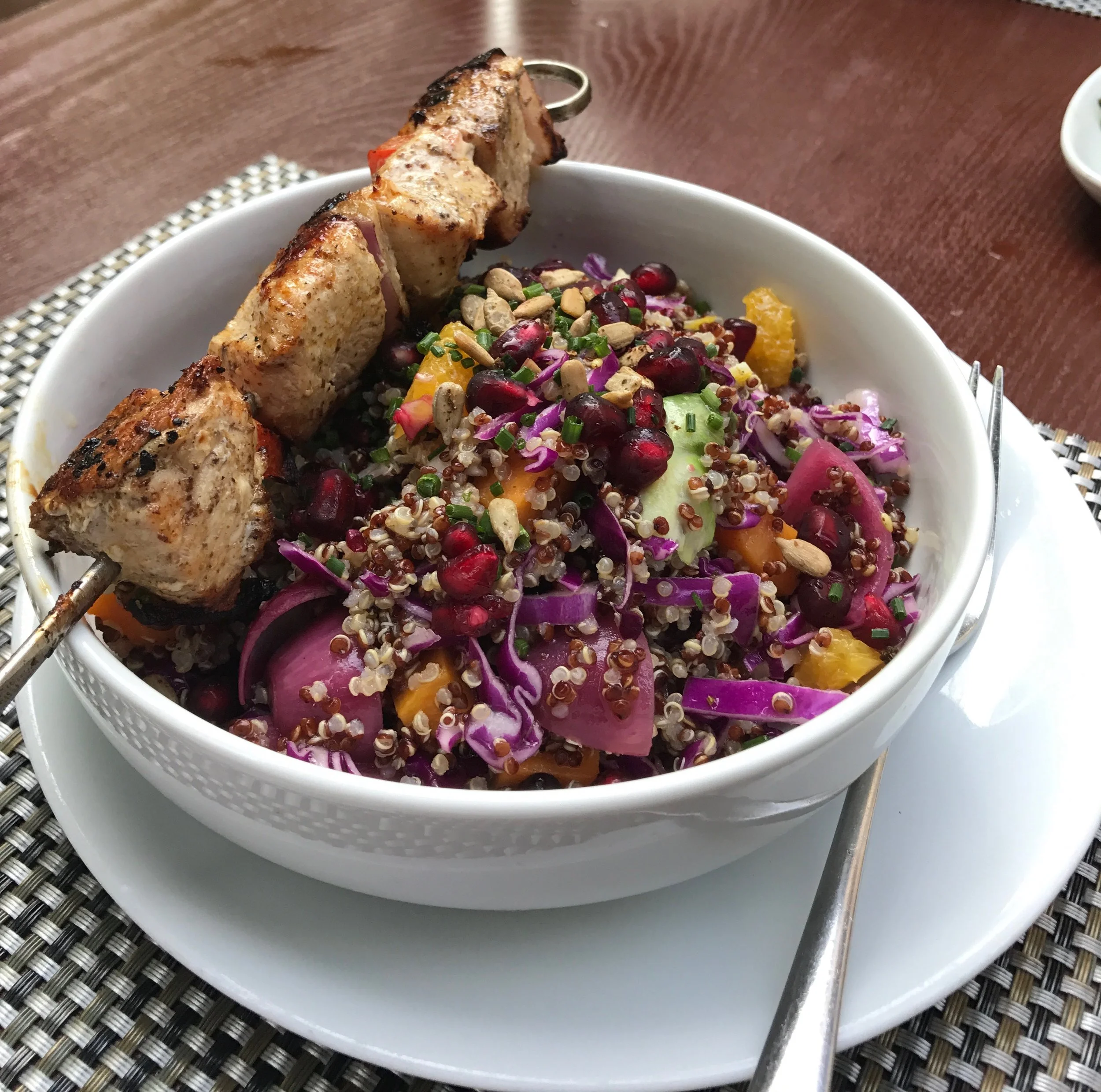
3 Awesome Tips to Make Cooking at Home Easy
Your Nutrient Intake
Are you finding that despite meditating, yoga and trying to be physically active, that you really aren’t feeling as well as you could? Perhaps you need to take a closer look at your nutrient intake. Notice I did not say “nutritional.” That’s because we tend to focus on carbs, proteins, fats; which ones to eat and which ones to avoid. But we forget that the foods we eat are also supposed to give us nutrients that help our bodies to function optimally and remove toxins that come from what we ingest or even from everyday metabolic functions of our body!
Your Nutrient Intake
Are you finding that despite meditating, yoga and trying to be physically active, that you really aren’t feeling as well as you could? Perhaps you need to take a closer look at your nutrient intake. Notice I did not say “nutritional.” That’s because we tend to focus on carbs, proteins, fats; which ones to eat and which ones to avoid. But we forget that the foods we eat are also supposed to give us nutrients that help our bodies to function optimally and remove toxins that come from what we ingest or even from everyday metabolic functions of our body!
Micronutrients and Resiliency
The food we have available to us from mother nature; whole, natural foods, are complete packages of mixed nutrients in the right amounts and the right mix to help our complex bodies function. When we allow our bodies to absorb and use these nutrients, we stay healthy and resilient.

By nutrients, I’m referring to the vitamins, the minerals and the phytonutrients in foods - a.k.a “micro-nutrients.” These micronutrients help turn that carb, protein or fat into energy, hormones, parts of cells and so on. They even help eliminate toxins from our body! To make sure we are getting enough, we need to eat more of plant-based, whole-foods; not one filled with processed and packaged foods.
The best way to ensure you are getting these nutrients is to make more meals at home. I know what you are thinking: “How am I going to find the time to make meals from these whole, natural foods? It’s so much work!” Well, this is your lucky day! Below are my top 3 tips to get you eating a more colourful, plant-based, whole foods diet and cooking more at home. Enjoy!
My 3 Favourite Hacks for Amping Your Nutrient Intake!
Batch Cooking (grains, soups, stews, sauces, chilli, beans)
If you are going to cook something, why not double the recipe and freeze half to eat on those days when your time is short? Making a homemade vegetable soup? Make double and freeze half. Don't forget to label the dish using masking tape and permanent marker so you know what it is later.
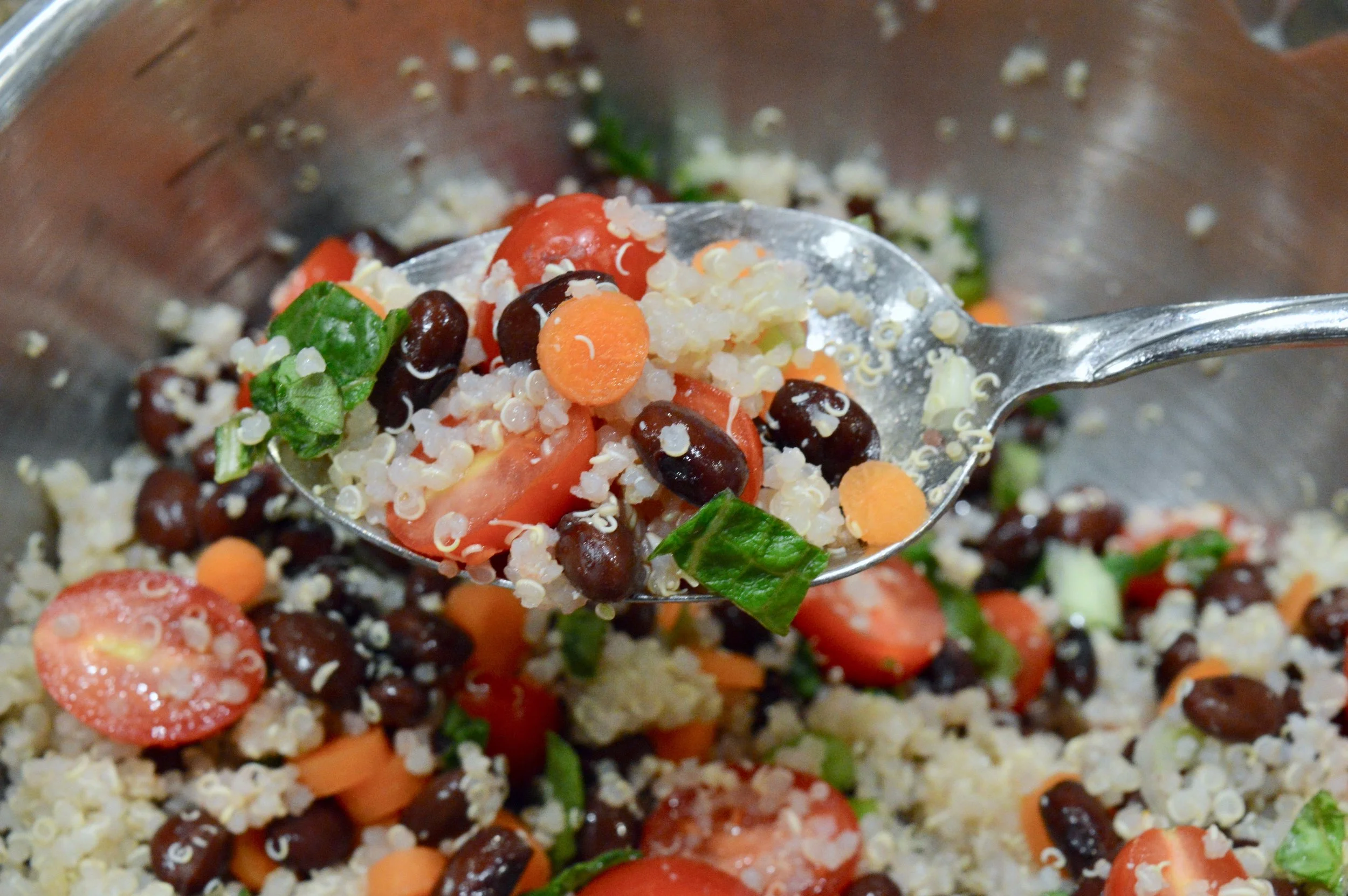
When I cook up grains like quinoa or even dry beans and lentils, I do the same thing. Instead of just making a cup, cook the whole bag. When it’s cooled, put some in the fridge to add to salads throughout the week. Place the rest in 1 cup portions in ziplock bags in the freezer. Whenever your recipe calls for it, just pull it out, thaw and voila! Grains, beans and lentils last for about 4-5 days in the fridge, (don’t refrigerate reheated portions), and in the freezer for about 3 months.
Quinoa is an excellent grain to do this with. You can use it in many ways: baking, adding more protein to salads, making a side dish for dinner, adding to stews and hot meals made with ground meat to add more substance and reduce the amount of ground meat used.
2. Stock Your Pantry and Freezer With Essentials.
Then you can whip up a meal in no time: Here are my favourites:
With these ingredients, you can whip up vegetarian bean chilli in no time at all. Or how about lemon and herb roasted salmon with roasted broccoli, lemon-dijon vinaigrette and a side of quinoa? It can be ready in 30 minutes!
3. Batch Preparing
Much like batch cooking above, this is where you take some of the preparation steps, one step further to cut down on time later. For example, let's say you need to chop some onions for a recipe, why not chop a whole bunch of onions and then freeze the extra chopped onions in ziplock bags for later use? You can do the same with garlic, ginger.

This is also great for baking as you can combine the dry ingredients in a package to pull out later. To do this, have 4 large ziplock bags open when you are about to bake muffins or a loaf or any other snack. Then, as you measure out the dry ingredients for your recipe, also measure out the same dry ingredient amount into each of the ziplock bags. So, for example, 1 cup of oats into your mixing bowl and then 1 cup of oats into each of the ziplock bags and so on.

When you are done, you will have the mixing blow with the dry ingredients of what you are about to bake and 4 other ziplock bags with the same dry ingredients. Label the bags and the next time you want to bake, just pull one out and add in the wet ingredients! Time saved!
BONUS:
The Salad Bar Hack:

Do you ever just run out of time to getting lunches ready for the week? This was something I ran into all the time so I came up with this hack to make sure I still eat healthy at work. Next time you go to the local grocery store visit the salad bar and pick up some mixed bean salad or a roasted vegetable salad as well as some chopped kale salad. Kale is a hardy, leafy green that won’t get soggy when you mix it with dressing and will keep longer. When you get home, mix the salads together, add some fresh lemon on top and voila! A hardy and tasty salad lunch that you can have for at least the next 3 days!
My Nutritional Training:
Harvard Medical School “Foods That Heal”, Arizona Centre of Integrative Medicine - Cardiovascular Health and Nutrition (6hr course), Functional Medicine - Cleveland Clinic (5-day course), CHEF (Culinary Health Education Fundamentals) coaching- Harvard Medical School & Institute of Lifestyle Medicine (15 hr course)